
Giving customers more control over their delivery experience
In shortBecause Getcho operates on both sides of checkout – the promise shown to the customer as well as the actual fulfillment – it has the unique ability to give the customer control over their own logistics.
Giving customers more control over their delivery experience
You know what’s a real shame? When a customer’s delivery experience is worse for no good reason. Some examples:
When minutes really matter
A customer places an urgent order with one-day shipping. There are no quicker delivery options and the customer really needs it before 4pm tomorrow. They take a bit of a risk with the order; it’s all they can do.
FedEx Overnight and courier delivery happen to cost the same. Courier gets there 20 hours earlier, but they both hit the one-day shipping requirement that the brand has promised. The shipper sees FedEx first in the shipping options, so FedEx it is. It arrives at 5pm and is of no use to the customer.
Everyone pretty much did everything right, yet the customer had a bad experience.
A perfect scenario – shipped via courier, delivered early – costs the same. How tantalizing; if only the shipper knew.
Speeding into red lights: when delivery speed doesn’t matter
On the flip side, faster is not always better.
Example: a corporate gifting company pays extra for courier delivery of 17 gift baskets. Several of the recipients are out of town at the time of delivery. The baskets sit on porches for 40 hours.
UPS Ground would have cost half as much and arrived more conveniently. If only the shipper knew.
Shopify checkout: the disconnect between shipper and customer
Some version of the above plays out all the time. It’s like there’s an invisible brick wall between the customer and the shipper; the customer can communicate very little – usually just a choice between vague ‘standard’ and ‘expedited’ options. Why can’t a shopper say “I need it for an event at 8pm this Thursday, best if it’s there after work hours”?
That’s a rhetorical question. They can’t because it would mostly be a waste of time for shippers and shoppers to communicate so precisely.
Even listing a bunch of shipping services directly is counterproductive. Let’s look at an example delivery.
Here’s a checkout that lists UPS Ground, USPS Priority Mail and FedEx Overnight. UPS Ground is the cheapest. This is, however, an extremely urgent order… let’s pay 4x as much for overnight air.
In fact, for these origin and destination zip codes, it just so happens that UPS Ground arrives tomorrow 99% of the time and FedEx Overnight does so 97% of the time.
Now, FedEx Overnight may offer money back on the shipping if it misses the one-day SLA, and the selection itself may boost this order’s priority for the packing team. But what an inefficient way to communicate.
Getcho’s strategies to give customers better shipping options
The Getcho Platform connects with:
- Shopify shipping options via Shopify Carrier Rates
- The Shopify cart (slide-in drawer or page) via Getcho’s Shopify App
- A vast array of carriers: national carriers like UPS, FedEx and USPS; regional carriers like Veho, OnTrac, UniUni and Gofo (through Parsel); and dozens of courier fleets.
Because Getcho operates on both sides of checkout – the promise shown to the customer as well as the actual fulfillment – it has the unique ability to give the customer control over their own logistics. The result is a higher checkout conversion rate for brands (we’ve grown the checkout-to-transaction rate by double-digit percentages for our customers) and a vastly superior customer experience.
Here are some of the specific strategies we use.
More shipping options
Brands and retailers might consider many things when deciding which shipping services to offer: carrier contracts, carrier pick-ups (when the UPS guy comes by), brand preferences, perceived customer preferences, packing time, etc.
Having said that, brands that offer only some sort of standard shipping miss an opportunity, especially when timing is vague. This customer comment on Hacker News sums it up:
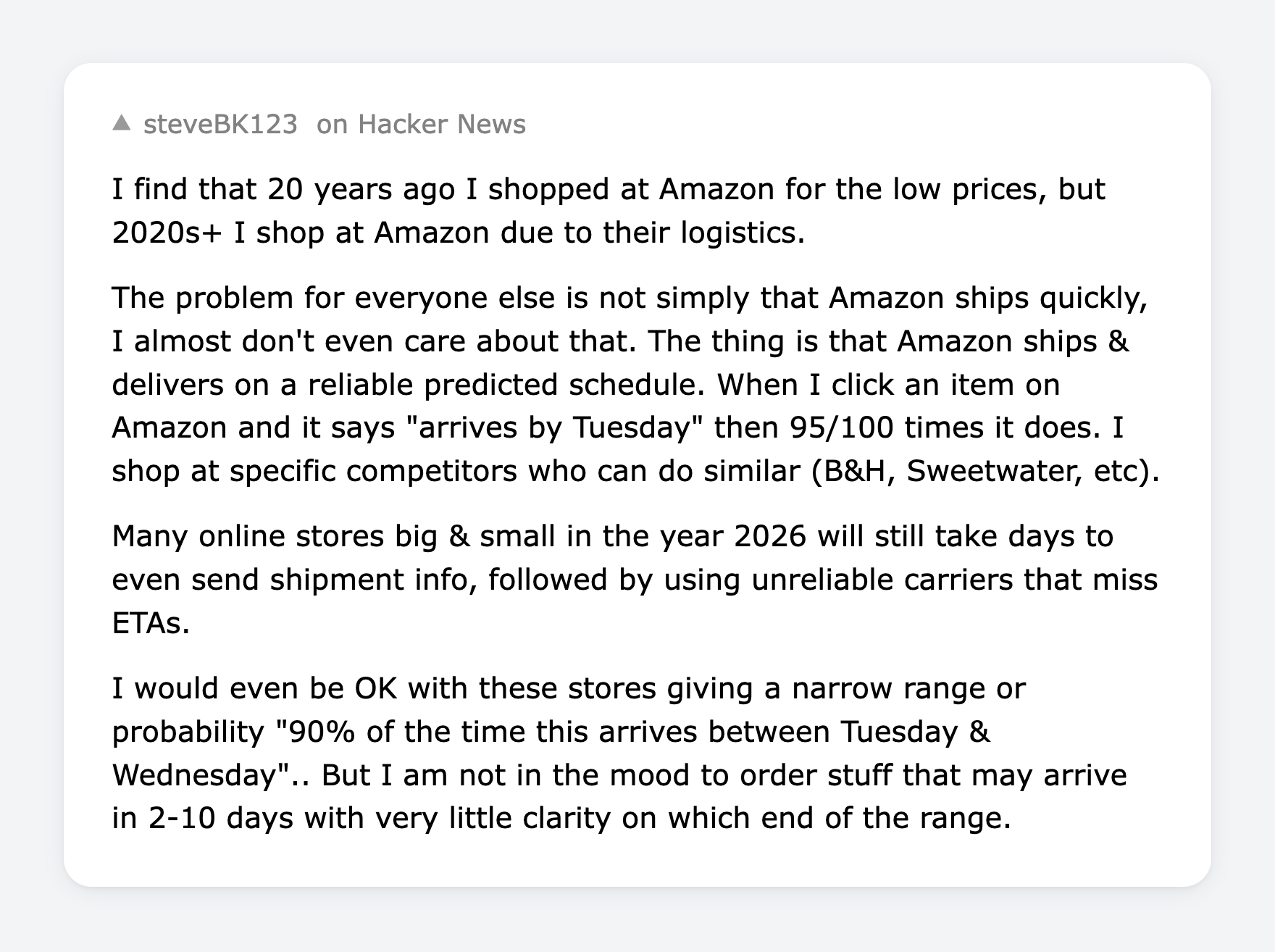
Getcho helps partners think in terms of the customer’s expectations. Usually the customer does some combination of minimizing cost and hitting a deadline. At a minimum, offering both a standard and an expedited shipping option gives them more latitude to do both.
How Getcho helps: Getcho provides a list of potential shipping options that brands can enable as a function of the SKUs they sell (“surfboards might only ship via UPS with a size surcharge”), their processing time, and where their customers are located. Included are reliability scores and on-time delivery rates; turning on a shipping option is as simple as checking a box, and the Getcho App will flag gaps in a shipping profile like “recommendation: provide a 2-day shipping option”.
Shipping options in the customer’s terms: named delivery services vs generic timing
Sometimes, however, more shipping services only serve to overwhelm. The customer thinks in terms of timing and cost first and reliability second. It’s not their job to figure out when a USPS Priority Mail package will arrive vs a UPS Ground package, nor to make sense of 6 different overlapping shipping options.
So instead of naming carriers, Getcho lets brands present options by timing: “Next Day Shipping” rather than “FedEx Overnight”. This is a lot more economical for all parties. If a customer chooses a named service, that’s what they should get, even if their zone is serviceable by UPS Ground in one day as well, and even if that means spending $30 on a functionally equivalent service. If they choose “Next Day Shipping”, the brand can make a more informed shipping decision that pushes net logistics costs way down.
Cart widgets for exact delivery timing
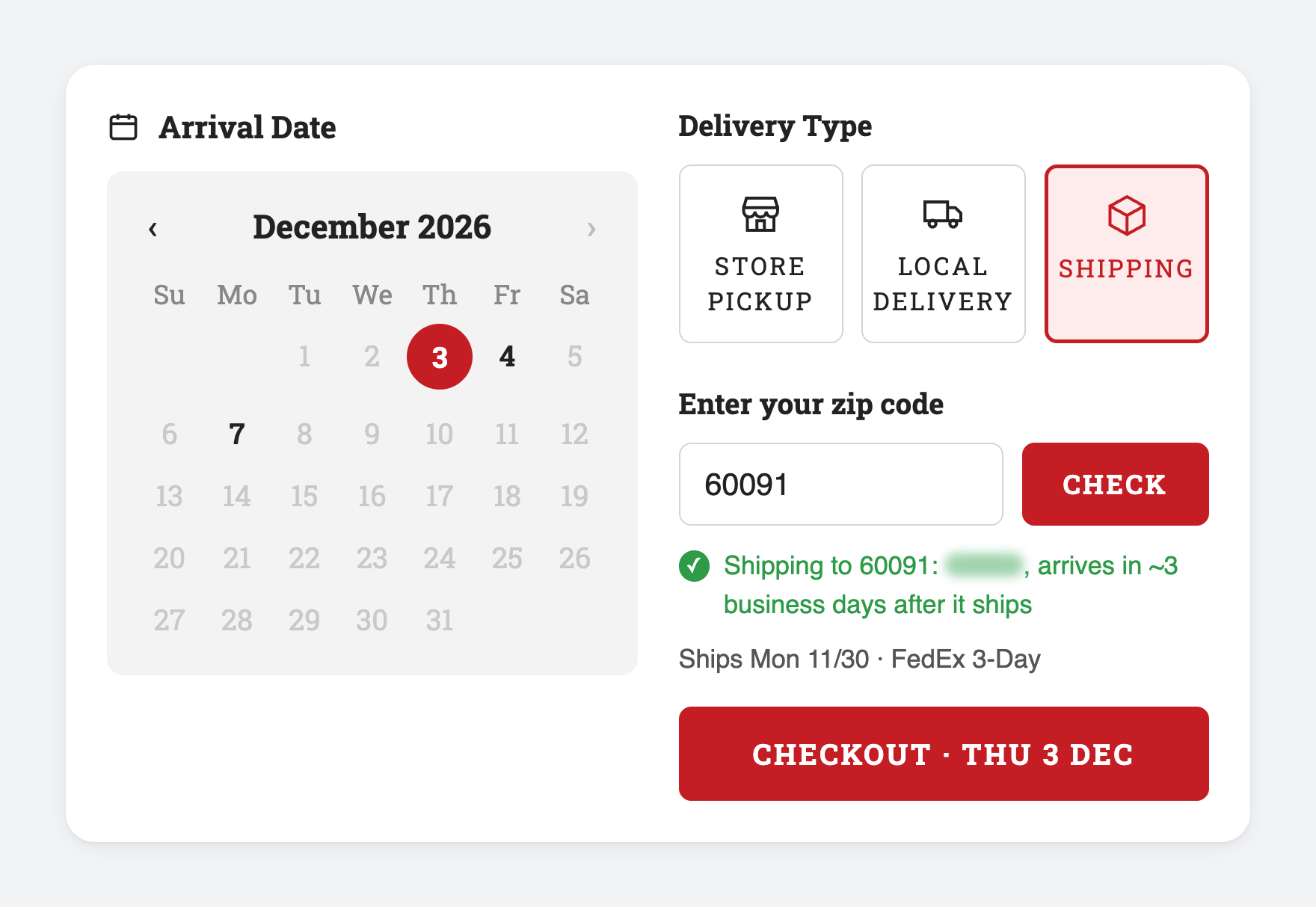
The Getcho App optionally provides several different cart widgets that influence the delivery method and shipping service. Shipping options in general appear on the checkout page; Shopify carts provide a more flexible interface to make selections, especially since many customers don’t click through the entire shipping list on the checkout page.
Food and beverage businesses love to use these widgets since perishable goods have tighter shipping requirements.
Allowing customers to upgrade their delivery timing from the tracking page
Fulfilling an order on Shopify attaches a tracking link to the order and optionally notifies the customer with the current status.
Heading into 2027, we have found the tracking link to be an underutilized tool. Customers view Getcho tracking links, on average, 4 times per order. They receive tracking links the moment an order is fulfilled. So businesses using Getcho can allow their customers to modify shipping after the fact:
- Customers can pay to upgrade shipping before an order is out the door (must be enabled by the business).
- Local delivery customers can choose one-hour delivery windows, which determine the courier’s pick-up day and time.
Tap the screen to go to the next step.